
It was the late seventies when I and a lot of other people dramatically reduced their consumption of veal. A portion of the change was for humane reasons. But it was mostly about dollars and sense.
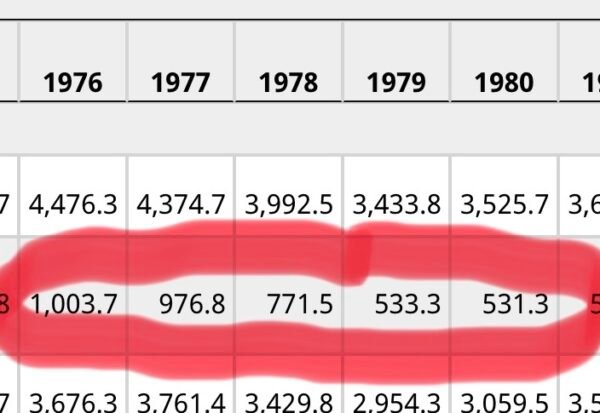
Veal had become more and more expensive and the consumption of veal calves in Canada had been cut in half. Why would I order Veal Parmesan when I could get Fettuccine Alfredo for half the price? Why would my wife make osso buco from veal shanks when beef would cut the cost in half.
So it may be a little strange for you to hear that, last week, I had veal. Twice.
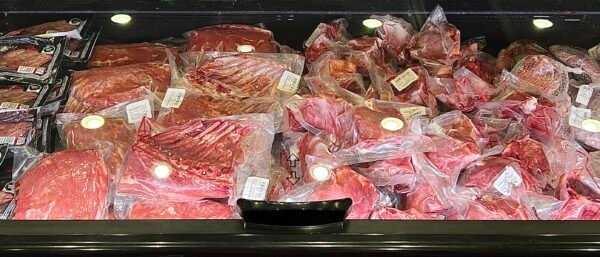
I was in San Miguel’s super (for some things) City Market. I was looking for lamb. I went over to the freezer tub and ouch! The racks were priced at $1400 a kilo. A few feet over though, there was what looked like more lamb. I picked up a rack. It was a little bigger. The bones hadn’t been Frenched. It was priced at $380 a kilo. An appetizing number.
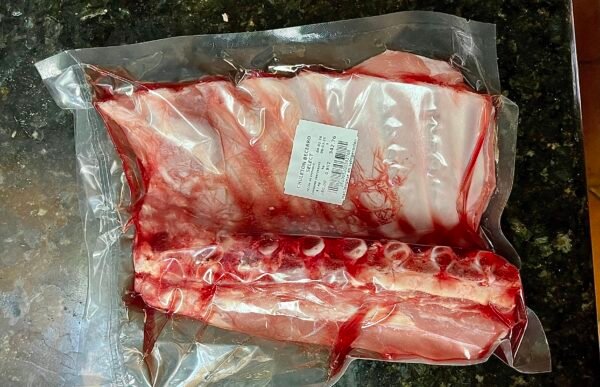
The label said “Chuleton Becerro Select”. Chuleton is what I’d heard some Mexicans call ribeyes. But becerro? I had no idea. And I’m one of those ancient guys who doesn’t have a phone (if you don’t have one, you can’t lose one) so I couldn’t ask Google Translate for help.
I dug deeper in the tub. Most of the rest of the cuts in the pile were labeled ternera. I knew what ternera was. Ternera is veal. The chuleton becerra were veal chops, the cut that those fancy-dan Italian and French restaurants served in the days when I had an expense account. It was the part of a calf that is equivalent to the lamb’s rack. Into the cart the plastic wrapped pack went.
Before I tell you what my wife, Sharon, did with that rack of veal back ribs, let me tell you a little about the production of veal.
First of all, veal is a product not of the beef industry but a by-product of the dairy industry. In order to keep producing milk, every year a cow must get pregnant. If she produces a male calf, well obviously, it’s not much use.
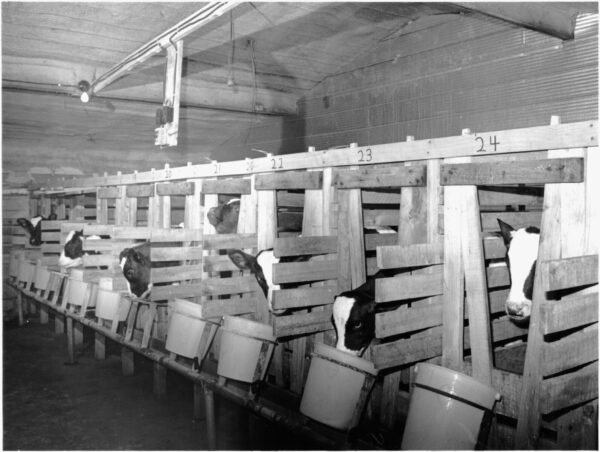
Most male dairy cattle are, sad to say, slaughtered. A few are lucky enough to become beef cattle but breeds like Holsteins and Jerseys that make great milk do not make great steaks.
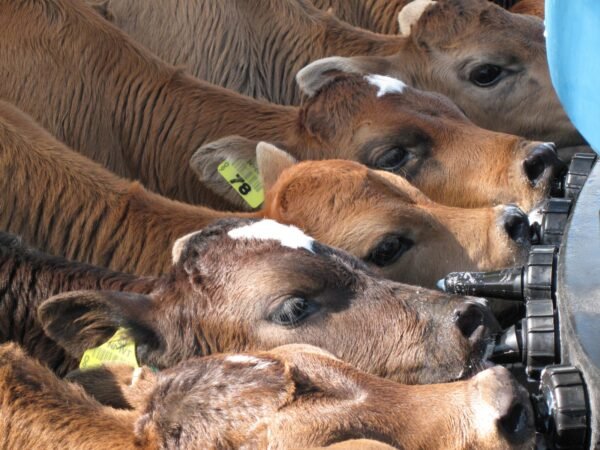
A few more are raised on milk, usually for four to six months before slaughtering, and become “white” veal and that rack I bought at City Market.
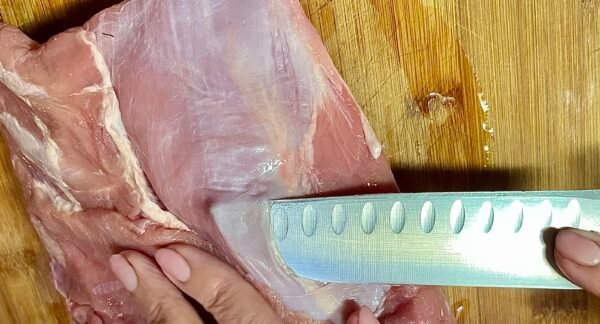
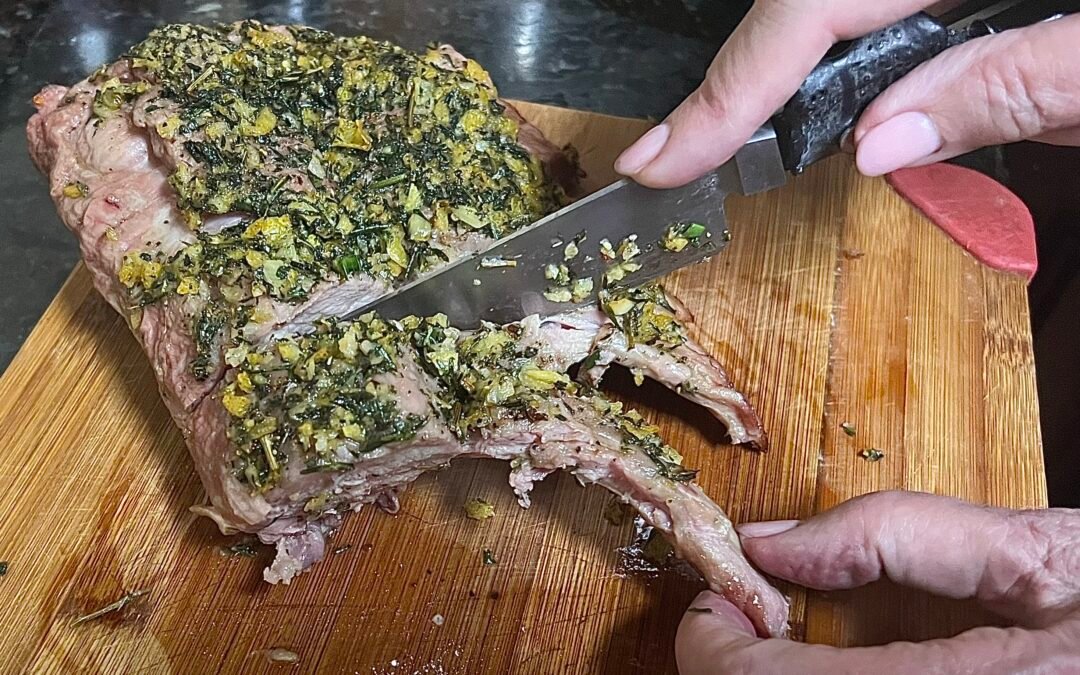
“A herb crust, that’s what I’m going to do with it”, said Chef Sharon as she snipped a little silverskin off, slit the ends of the bones apart and sent me off to our herb pots for sage, thyme and rosemary. I thought if we’d only grown one more spice I could hum a little Simon & Garfunkel as I picked.
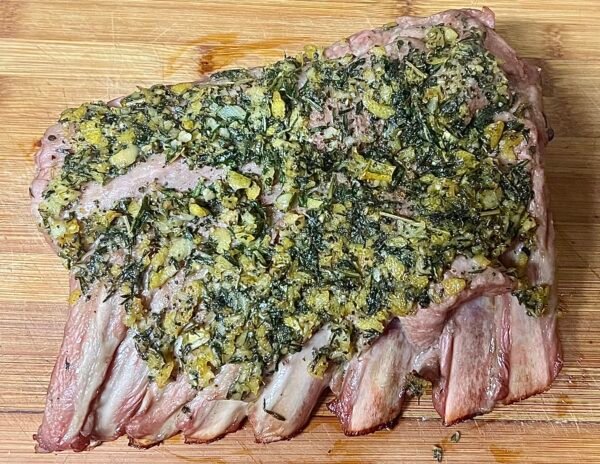
There was lots of that “white” veal. I’m guessing twice as much per rib as you get with lamb. Sharon mixed the three fresh herbs with minced garlic, lemon zest, dried tarragon, salt, pepper and olive oil and patted it all over the fleshy side. She then wrapped the rack in plastic wrap and put it in the fridge to marinate for several hours.
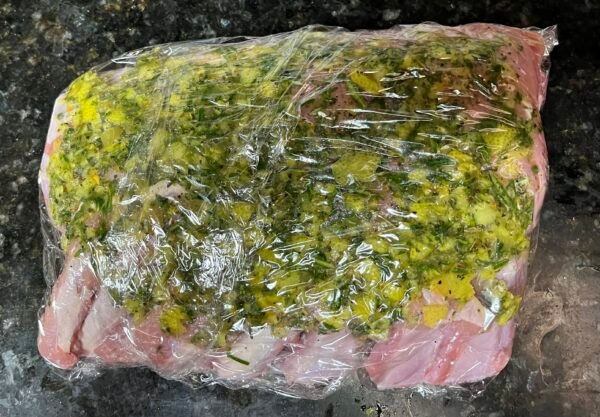
An hour before it went into the oven, she took it out of the fridge to come to room temperature, removed the plastic, and put it bone-side down on a rack in a roasting pan.
Sharon (yes, she supplied the words for this paragraph) then slow-roasted the rack at 225°F (110°C) until the internal temperature of the meat reached 135°F (57°C). Then, under the broiler it went until the top was nicely browned. After tenting and resting for 15 minutes, the internal temperature reached 145°F (63°C) which is medium rare to medium and ready for me to eat.
In the oven with the veal went a couple of Russets and, with so many herbs on the meat, we decided a green on the side wasn’t necessary. A little salt, pepper, butter, chopped onion greens and sour cream on the potatoes and we were ready to eat. The juices were oozing out of the meat. I was excited.
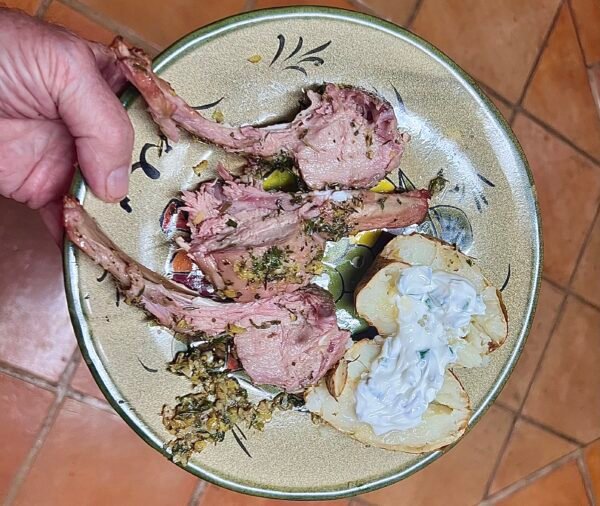
My distant memory of veal chops was that they were a little too mild in taste but I think that was because I always compared them to a prime rib. This time, instead, I compared them to loin lamb chops. It was iffy. They were close. But when I tasted that crispy, fatty, meat from next to the bone, veal sealed the victory.
Of course if I’d thought about the veal being a quarter of the price, I would have declared no contest.
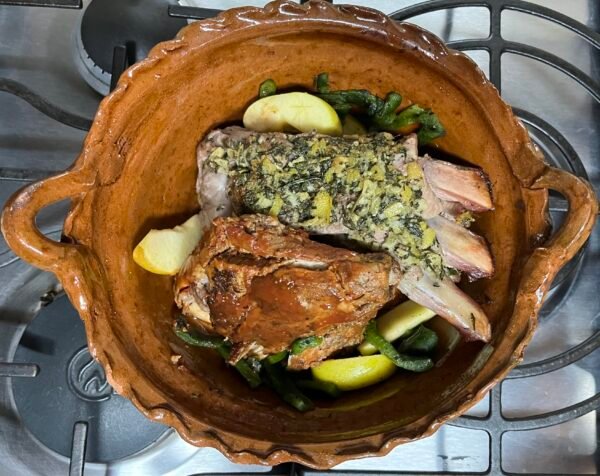
Cut now to two days later. And, like many other days in our home, Chef Sharon had to sell me on the joys of leftovers. The leftover veal chops were in the fridge. As were some leftover pork ribs from Silveyra’s. It wasn’t a difficult sell. Into a cazuela the meat went, along with some of those tiny apples that are available in the market at this time of year plus a chopped up poblano pepper. The chef creamed some cauliflower with harissa as a side.
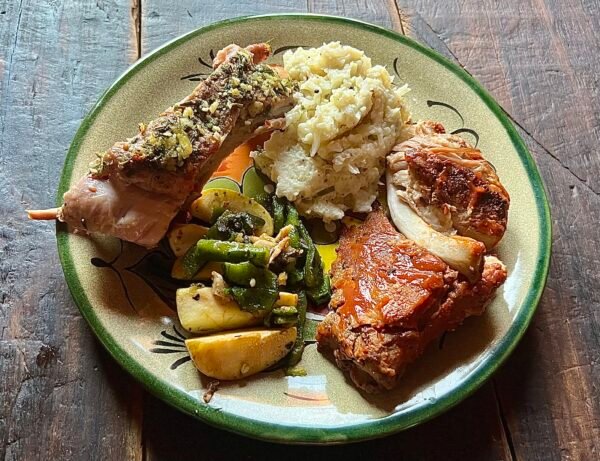
The veal rack was just as good as the first time, maybe even a titch better with a little more crisp on the bones. I put osso buco on my must-convince-Sharon-to-cook-soon list and City Market’s veal shank (chambarete ternera) on my must buy ($239 a kilo) list for the next grocery shop.
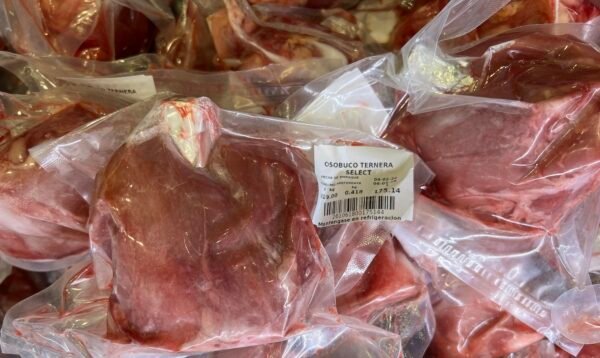
City Market is located at Salida a Celaya #82 in San Miguel de Allende, Mexico. There was a limited quantity of veal cuts in the freezer.
I spent my early years growing up on my Uncle John’s dairy farm in central Wisconsin. As a teen, I spent part of my summers helping feed and milk the cows and assisting mothers give birth to their calves. Many people oppose veal without realizing that the slender profit margins of a dairy farm mean that, without selling male calves, they would go out of business. It always surprised me that despite a thriving dairy industry in México, I could not find veal.
Ah, for a lightly done veal picatta.
Sounds absolutely yummy.
In the US veal ribs are often sold with a pocket for stuffing. Using a corn bread stuffing it roasts in a low oven for about an hour and is delicious b
… after reading your review, I doubt there are any left in the store’s freezer … but I will certainly keep an eye out for them ! Thanks for the recipe !
There were a lot more shanks than racks if that works (though we just stocked up on those as well).
Now I wonder how on earth you can live up to your name with No Phone? I would be lost without Maps in SMA! Great find, the veal.
WE COULD HAVE HAPPILY DONE WITHOUT THE LITTLE SUCKLING CALVES…INSENSITIVE
no disrespect … but knowing where your food comes from should not be a mystery … unless you are ok with lab grown meat … you would be amazed, maybe, at how many people don’t even know what veal is …
DISGUSTING YOU DID NOT NEED TO SHOW THE BABY ANIMALES
… ? … that’s the problem with current culture … they have no idea where their food comes from or how it’s raised or grown … what is really disgusting is to see how processed food with artificial flavoring and additives is made, and is the main state of most modern diets …